
Parallel CNN-Based Transient Stability Analysis
Published:
Overview
Parallel Convolutional Neural Network (CNN)-based Transient Stability Assessment (TSA) for power grids, implemented as a multi-channel time-series classifier with data-parallel training to reduce retraining time while preserving high accuracy (98.8% test accuracy on the NE 39-bus benchmark).
This work was developed as a CS 6230 project with Jerry Feng.
Problem Context
Power networks can be modeled as a graph (generation, transmission, demand nodes) with dynamic features such as voltage, angles, rotor speed, and power flows.
Transient stability asks whether the system can return to equilibrium after disturbances (generator outages, load changes, short circuits). In operations, we want a prediction that is both accurate and fast, using immediate (<1s) post-fault time-series features, and a pipeline that can be retrained frequently as new disturbances/status conditions appear.
Motivating gaps highlighted in the project:
- PDE time-domain simulation is accurate but slow
- Some fast pattern-recognition classifiers (e.g., SVM) sacrifice accuracy
- Many prior works emphasize accuracy but do not benchmark training time, scaling, or provide end-to-end open-source implementations
Data & Experimental Setup
Benchmark system: New England IEEE 39-bus system
Signals / channels: 10 generators, each with 5 channels
Disturbances: three-phase short-circuit faults (0.1–0.3s clearing times), with 80–120% generation/load profiles
Dataset size & class balance: 12,852 examples labeled stable/unstable (≈58% stable, 42% unstable)
Solution
A CNN-based TSA pipeline that:
- Treats TSA as multi-channel time-series classification (stable vs. unstable)
- Uses data-parallel training to accelerate retraining and support rolling updates
- Targets strong benchmark accuracy while emphasizing training-time scalability
Technical Approach
Model & Training
- Multi-channel CNN for post-fault trajectories
- Batch normalization to improve training speed, performance, and stability
- Lower data requirement than some baselines: uses generator-bus channels (10 generator buses) rather than requiring signals from all 39 buses
Parallelization Methods
- Data-parallel batch splitting with
tf.distribute.MirroredStrategy()to shard each Keras batch across available GPUs - Logical batch scaling (optionally scale batch size by
num_replicas_in_syncto keep per-GPU batch constant) - Im2Col convolution optimization via a custom
Im2ColConv2Dlayer (extract patches → reshape → GEMM → reshape back) to leverage high-efficiency matrix multiplies on GPU - Gradient AllReduce to average gradients across replicas without manual synchronization, maintaining consistent weight updates vs. single-device training
Results
- Test accuracy: 98.8% on the NE 39-bus system
- Reported as an improvement over older NN-based approaches and on par with multi-channel CNN methods in the literature (as summarized in the presentation)
Scaling Tests
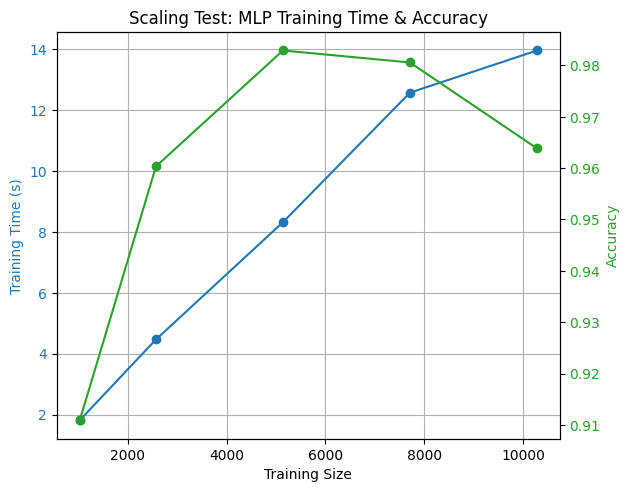
Below are scaling experiments showing how training time grows with training set size while accuracy remains strong.
Scaling Test Results (Time vs. Train Size, Accuracy vs. Train Size)

Baseline: MLP Scaling (Training Time & Accuracy)
Applications
- Real-time grid stability monitoring
- Preventive / corrective control support
- Emergency response decision support
- Fast screening of contingencies under changing operating conditions
Technical Stack
- Framework: TensorFlow / Keras (
tf.distribute.MirroredStrategy) - Language: Python (Jupyter Notebooks)
- Compute: Multi-GPU data parallelism + optimized convolution (Im2Col + GEMM)
Limitations & Future Work
- Validate scaling with throughput metrics (e.g., images/sec) as GPUs increase; tune batch size and learning rate
- Evaluate on larger systems (e.g., Polish 2383-bus) to study overheads and scaling limits
- Extend beyond binary stability to multi-class (e.g., oscillatory vs. aperiodic instability modes)
- Explore alternative architectures: GNNs for topology-aware modeling; CNN+GAN hybrids reported to improve accuracy; and parallelization beyond data-parallelism
Links
- GitHub Repository
- Topics: TensorFlow, Parallel Computing, CNN, Power Systems, Transient Stability