
LeadGen.AI
Published:
Overview
LeadGen.AI is an AI-powered lead generation and automated outreach platform designed for B2B sales teams. The system intelligently identifies qualified prospects by analyzing industry events, company profiles, and stakeholder data, then generates personalized outreach messages at scale.
Originally built for DuPont Tedlar’s Graphics & Signage team, the platform is architected with scalability and generalizability in mind - ready to be adapted across different product teams and industries.
Problem Statement
Traditional B2B lead generation is time-consuming and inefficient:
- Sales teams manually research industry events and trade shows
- Identifying decision-makers at target companies requires extensive networking
- Creating personalized outreach messages for each prospect is labor-intensive
- Qualifying leads against ideal customer profiles happens inconsistently
LeadGen.AI automates this entire workflow while maintaining high personalization quality.
Demo Video
Key Features
🎯 Ideal Customer Profile (ICP) Management
- Define and save multiple ICPs with industry, revenue, size, and geographic criteria
- Reuse profiles across different campaigns
- Track performance metrics for each ICP
🔍 Event-Based Lead Discovery
- Live web scraping of industry events (FESPA, trade shows, conferences)
- Source citation and verification for all event data
- Exhibitor identification and company extraction
- Custom CSV upload for proprietary company lists
📋 Stakeholder Persona Targeting
- Define target roles: Decision Makers, Influencers, End Users
- Job title and department filtering
- LinkedIn Sales Navigator integration (in development)
- Multi-persona targeting within organizations
🤖 AI-Powered Lead Qualification
- Strategic relevance scoring based on custom criteria
- Company size, revenue, and growth stage filtering
- Technology stack and funding status filters
- Match percentage calculation with detailed reasoning
💼 Intelligent Data Enrichment
- Company profile enhancement (technologies, funding, news)
- Stakeholder contact information discovery
- Competitor analysis
- Industry engagement metrics
✉️ Personalized Outreach Generation
- Context-aware message templates
- ICP and persona-specific customization
- Multiple channel support (email, LinkedIn)
- A/B testing capabilities
📊 Lead Management & Export
- Sortable, filterable lead tables
- Status tracking (New, Contacted, Qualified, Disqualified)
- CSV and JSON export formats
- CRM integration ready (in development)
Technical Architecture
Tech Stack
Frontend:
- React with TypeScript
- Vite for build tooling
- Tailwind CSS for styling
- shadcn/ui component library
Backend:
- Node.js/Express server
- PostgreSQL database with Drizzle ORM
- OpenAI GPT-4 for AI generation
- Web scraping with Cheerio/Puppeteer
Data Flow
- Input Layer: User defines ICP and selects target events
- Discovery Layer: System scrapes event exhibitors and company data
- Processing Layer: AI analyzes companies against ICP criteria
- Qualification Layer: Scoring, filtering, and ranking of leads
- Enrichment Layer: Additional data gathering for qualified leads
- Output Layer: Personalized messages and exportable lead lists
User Workflow
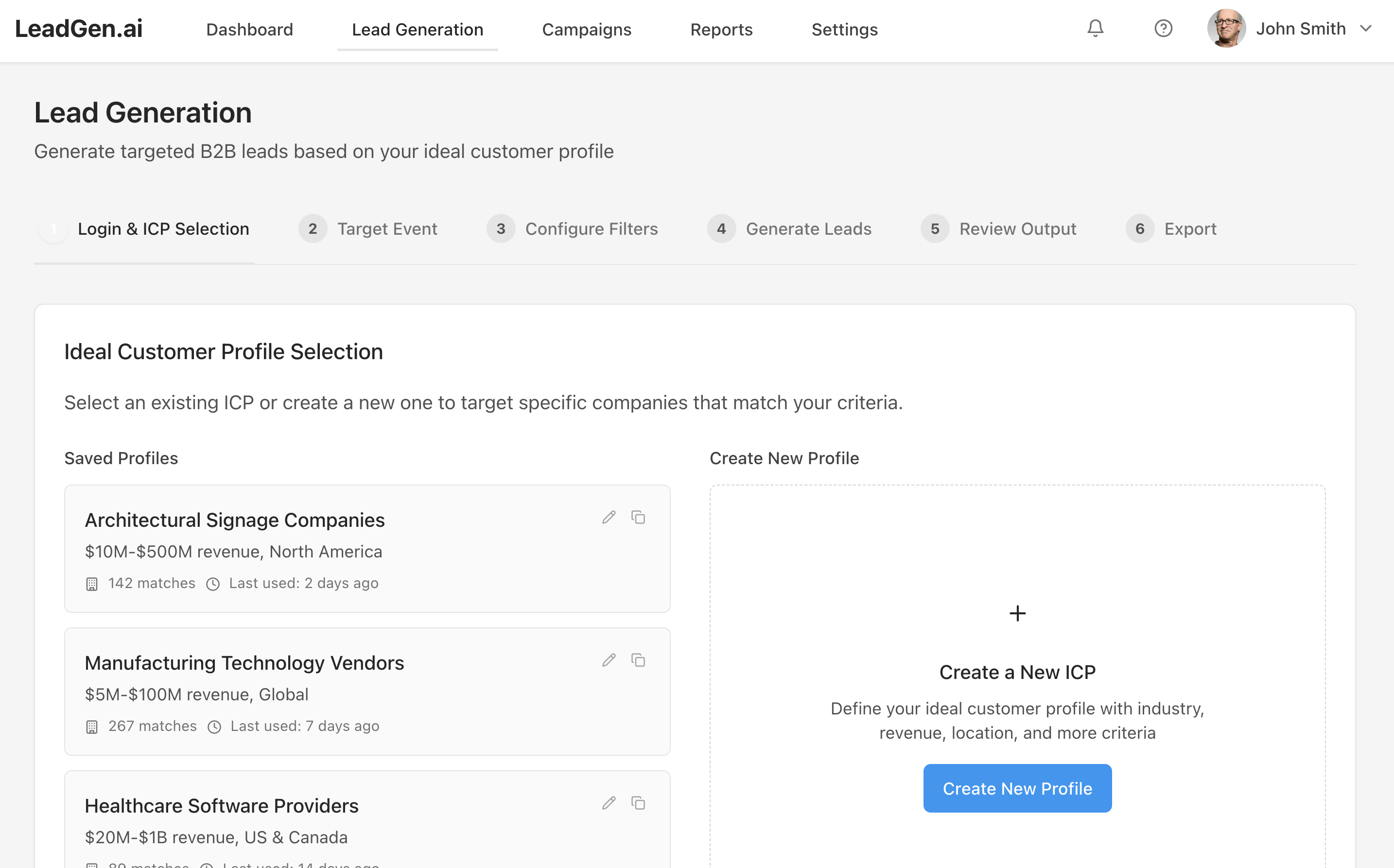
Step 1: ICP Selection/Creation
- Browse existing ICPs or create new profiles
- Define industry, size, revenue, geography, and custom criteria
- Save for future campaigns
Step 2: Target Event Selection
- Browse live-scraped industry events with exhibitor counts
- View source citations for transparency
- Sync latest events with one click
- Alternative: Upload custom company lists via CSV
Step 3: Configure Filters
- Stakeholder Personas: Define target roles and titles
- Strategic Qualification: Set company size, revenue thresholds
- Relevance Criteria: Industry engagement, market activity, innovation focus
- Additional Filters: Technology stack, funding status, keywords
- Generation Options: Lead count, enrichment toggle, message generation
Step 4: Identify Decision Makers
- LinkedIn Sales Navigator search (in development)
- Job title and company filtering
- Relevance scoring with rationale
- Contact information discovery
Step 5: Generate & Review Leads
- AI analyzes event data against ICP
- Each lead includes:
- Company profile and stakeholder details
- Match percentage with detailed reasons
- Enrichment data (technologies, funding, news)
- Personalized outreach message
- Filter, sort, and update lead status
Step 6: Export & Integrate
- Export to CSV or JSON
- Select fields and filtering options
- Import into CRM systems
- Begin outreach campaigns
Implementation Highlights
AI-Powered Lead Scoring
The system uses GPT-4 to analyze companies against multiple criteria:
const qualificationPrompt = `
Analyze this company against the following ICP criteria:
- Industry: ${icp.industry}
- Revenue Range: ${icp.minRevenue} - ${icp.maxRevenue}
- Employee Count: ${icp.minEmployees} - ${icp.maxEmployees}
- Strategic Criteria: ${strategicFilters}

Company Data:
${companyProfile}

Provide:
1. Match score (0-100)
2. Specific reasons for the score
3. Key alignment factors
4. Potential concerns
`;
Web Scraping Pipeline
Live event data extraction with citation tracking:
async function scrapeEvents() {
  const events = await scraper.fetch('https://fespa.com/events');

  return events.map(event => ({
    name: event.title,
    date: event.date,
    location: event.location,
    exhibitorCount: event.exhibitors.length,
    sourceUrl: event.url,
    lastUpdated: new Date()
  }));
}
Personalized Outreach Generation
Context-aware message creation:
const messagePrompt = `
Create a personalized outreach message for:

Recipient: ${stakeholder.name}, ${stakeholder.title}
Company: ${company.name}
Context: Met at ${event.name}

ICP Focus: ${icp.industry}
Key Value Props: ${icp.valuePropositions}

Match Reasons: ${lead.matchReasons}

Generate a professional, concise message that:
1. References the event context
2. Highlights relevant value propositions
3. Includes a clear call-to-action
`;
Results & Impact
- Time Savings: Reduces lead research time from hours to minutes
- Personalization at Scale: Generates hundreds of customized messages automatically
- Quality Improvement: AI scoring ensures consistent lead qualification
- Data Transparency: Source citations build trust in lead quality
- Workflow Integration: Export capabilities enable seamless CRM adoption
Future Enhancements
Near-Term Improvements
- Multiple Event Selection: Select and analyze multiple events simultaneously
- Progress Indicators: Real-time generation progress bars and animations
- CRM Integration: Direct export to Salesforce, HubSpot, and other platforms
- Match Detail Transparency: Detailed criteria matching with source attribution
Long-Term Vision
- LinkedIn API Integration: Full Sales Navigator integration for richer stakeholder data
- Feedback Loop: User interaction tracking to improve AI recommendations
- Multi-Channel Outreach: Email, LinkedIn, and call script generation
- Analytics Dashboard: Campaign performance tracking and ROI metrics
- Team Collaboration: Shared ICPs, lead assignments, and activity tracking
- Industry Expansion: Pre-built ICP templates for various verticals
Technical Challenges Solved
Challenge 1: Dynamic Web Scraping
Events websites frequently change structure. Solution: Flexible scraping patterns with fallback strategies.
Challenge 2: Data Quality
Inconsistent company information across sources. Solution: Multi-source validation and confidence scoring.
Challenge 3: AI Consistency
GPT outputs can vary. Solution: Structured prompts with JSON schema enforcement and temperature tuning.
Challenge 4: Scale & Performance
Processing hundreds of companies efficiently. Solution: Batch processing, caching, and async operations.
Installation & Setup
# Clone repository
git clone https://github.com/nicolehao34/LeadGen.AI.git
cd LeadGen.AI

# Install dependencies
npm install

# Set environment variables
export OPENAI_API_KEY=your_key_here

# Start development server
npm run dev

# Access at http://localhost:3000
Links
- GitHub Repository
- Technical Documentation
- Topics: AI Agents, Lead Generation, B2B Sales, Web Scraping, GPT-4, TypeScript